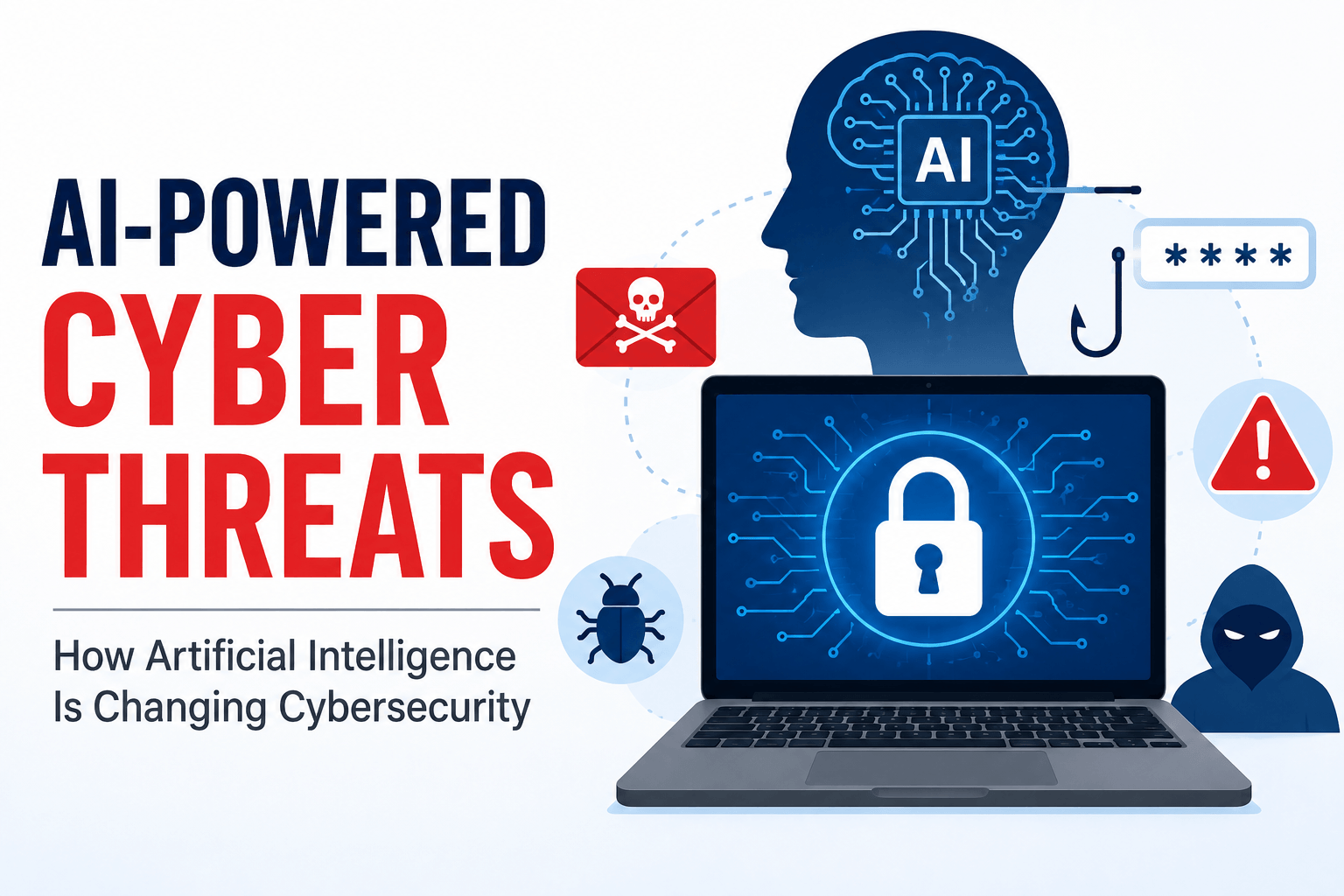
AI-Powered Cyber Threats: How Artificial Intelligence Is Changing Cybersecurity in 2026
Artificial Intelligence (AI) has revolutionized industries worldwide, from healthcare and finance to marketing and education. However, as organizations embrace AI to improve efficiency and productivity, cybercriminals are also leveraging the same technology to launch more sophisticated and dangerous attacks.AI-powered cyber threats are becoming one of the biggest cybersecurity concerns in 2026.
Unlike traditional cyberattacks, AI-driven attacks can learn, adapt, and automate malicious activities at an unprecedented scale. This makes them harder to detect and more effective than ever before.
Businesses, governments, and individuals must understand how these threats work and what measures can be taken to defend against them. In this article, we will explore AI-powered cyber threats, their impact on cybersecurity, common attack methods, and practical strategies to stay protected.
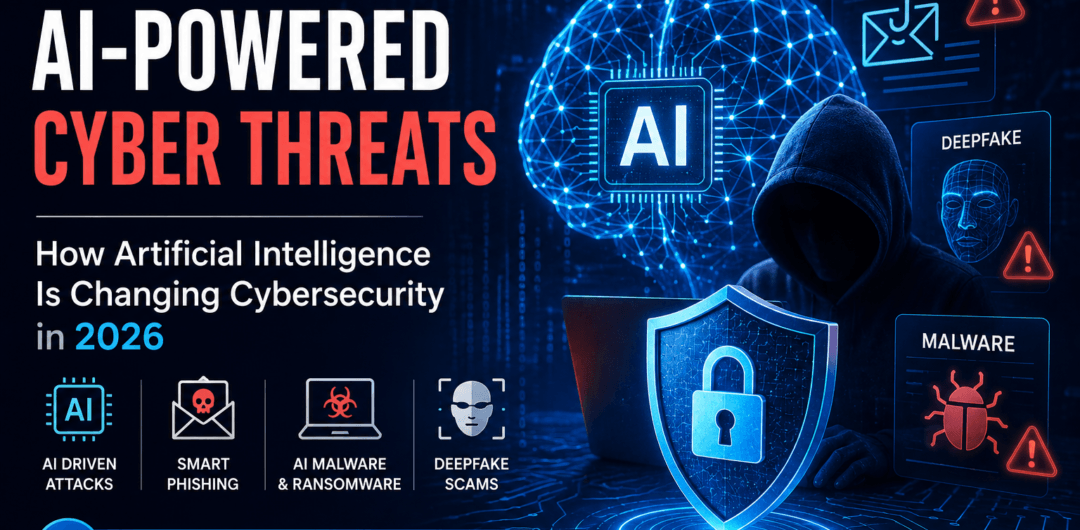
What Are AI-Powered Cyber Threats?
AI-powered cyber threats are cyberattacks that use artificial intelligence, machine learning, or automation technologies to improve the effectiveness of malicious activities.
These attacks can:
Analyze large amounts of data
Identify vulnerabilities automatically
Create convincing phishing messages
Evade security systems
Automate malware deployment
Mimic human behavior
By using AI, cybercriminals can launch attacks faster and with greater precision than traditional hacking techniques.
Why AI Is Attractive to Cybercriminals
Cybercriminals constantly seek new ways to maximize their success rates while minimizing effort. AI offers several advantages:
Automation
AI can automate repetitive hacking tasks, allowing attackers to target thousands of victims simultaneously.
Speed
AI systems can process information and identify vulnerabilities much faster than human attackers.
Adaptability
Machine learning algorithms can continuously improve attack strategies based on previous successes and failures.
Scalability
AI enables cybercriminals to conduct large-scale attacks with limited resources.
These benefits make AI a powerful tool in the hands of malicious actors.
Types of AI-Powered Cyber Threats
1. AI generated phishing attacks
Phishing remains one of the most common cyber threats, but AI has made it significantly more dangerous.
Traditional phishing emails often contain grammar mistakes and generic messaging. AI can generate highly personalized and convincing emails that closely resemble legitimate communications.
Example
An AI system can analyze a victim’s social media profiles, company website, and online activities to craft personalized phishing messages.
As a result, victims are more likely to trust the email and click malicious links.
2. Deepfake Scams
Deepfake technology uses AI to create realistic audio, video, and image content.
Cybercriminals can impersonate:
CEOs
Managers
Government officials
Celebrities
Family members
Example
A company’s finance department may receive a phone call that sounds exactly like the CEO requesting an urgent wire transfer.
Employees may comply without realizing the voice is AI-generated.
3. AI-Powered Malware
Traditional malware relies on predefined instructions. AI-powered malware can adapt its behavior based on the environment it encounters.
These advanced threats can:
This makes AI malware far more difficult to detect and remove.
Avoid detection
Change attack methods
Learn security system patterns
Identify valuable targets
4. Automated Password Attacks
AI can significantly improve password-cracking techniques.
Machine learning algorithms analyze user behavior and commonly used passwords to generate more accurate password guesses.
Benefits for attackers include:
Faster password cracking
Improved success rates
Reduced computational resources
Weak passwords become even more vulnerable in the age of AI.
5. Intelligent Bot Attacks
Bots powered by AI can mimic human behavior more effectively than traditional automated scripts.
These bots can:
Create fake accounts
Conduct fraud
Scrape sensitive information
Manipulate online reviews
Bypass CAPTCHA systems
Businesses face increasing challenges in distinguishing real users from AI-powered bots.
6. AI-Driven Social Engineering
Social engineering attacks manipulate human psychology rather than exploiting technical vulnerabilities.
AI helps attackers:
Gather personal information
Analyze behavior patterns
Create convincing messages
Build trust with targets
The result is highly personalized scams that are difficult to recognize.
The Impact of AI-Powered Cyber Threats
Financial Losses
Cyberattacks can result in:
Direct financial theft
Ransomware payments
Business interruption
Regulatory penalties
Organizations may lose millions of dollars from a single successful attack.
Data Breaches
Sensitive information such as:
Customer records
Financial data
Intellectual property
Medical records
can be stolen and sold on criminal marketplaces.
Reputation Damage
Customers expect businesses to protect their data.
A major cyberattack can severely damage trust and brand reputation.
Operational Disruption
AI-powered attacks can disrupt critical systems, causing downtime and productivity losses.
AI-Powered Ransomware
Ransomware remains one of the most profitable cybercrime methods.
AI-enhanced ransomware can:
Identify high-value targets
Spread more efficiently
Avoid detection
Encrypt critical files faster
Some advanced ransomware strains can even determine which systems are most important to business operations before launching attacks.
This increases pressure on victims to pay the ransom.
How AI Is Also Fighting Cyber Threats
The cybersecurity industry is using AI to defend against AI-powered attacks.
Threat Detection
AI systems can analyze network activity in real time and identify suspicious behavior.
Behavioral Analysis
Machine learning helps detect unusual user actions that may indicate compromised accounts.
Malware Detection
AI can recognize malware patterns that traditional antivirus solutions might miss.
Automated Response
Security platforms can automatically contain threats before they spread throughout a network.
AI is becoming an essential component of modern cybersecurity strategies.
Best Practices to Protect Against AI-Powered Cyber Threats
Use Multi-Factor Authentication (MFA)
MFA adds an additional layer of security beyond passwords.
Even if attackers obtain login credentials, they will face additional verification requirements.
Train Employees Regularly
Human error remains a major cybersecurity risk.
Organizations should provide regular training on:
Phishing awareness
Social engineering tactics
Password security
Safe internet practices
Implement Zero Trust Security
Zero Trust assumes no user or device should be trusted automatically.
Verification is required for every access request.
Keep Software Updated
Cybercriminals often exploit outdated software vulnerabilities.
Regular updates help close security gaps.
Deploy AI-Based Security Solutions
Modern security platforms use AI to detect and respond to threats more effectively.
Businesses should consider:
AI threat detection systems
Endpoint protection
Security monitoring platforms
Network behavior analytics
Monitor for Deepfakes
Organizations should establish verification procedures for sensitive requests involving:
Financial transactions
Password resets
Data access requests
This helps reduce the risk of deepfake-based fraud.
Future of AI-Powered Cyber Threats
As artificial intelligence continues to evolve, cyber threats will become increasingly sophisticated.
Future developments may include:
Fully autonomous cyberattacks
Advanced AI-driven ransomware
More realistic deepfakes
Intelligent vulnerability discovery
Automated social engineering campaigns
At the same time, cybersecurity technologies will continue improving to counter these emerging threats.
The ongoing battle between attackers and defenders will likely become an AI-versus-AI competition.
Conclusion
AI-powered cyber threats represent one of the most significant cybersecurity challenges of the modern digital era. Cybercriminals are leveraging artificial intelligence to automate attacks, create convincing phishing campaigns, develop adaptive malware, and launch sophisticated social engineering schemes.
While these threats continue to evolve, organizations and individuals can reduce their risk by adopting strong cybersecurity practices, investing in AI-driven security solutions, and maintaining awareness of emerging attack techniques.
In 2026 and beyond, understanding AI-powered cyber threats is no longer optional—it is essential for protecting sensitive information, maintaining business continuity, and ensuring digital safety in an increasingly connected world.
Businesses that proactively prepare for AI-driven attacks will be far better positioned to defend themselves against the cybersecurity challenges of the future.